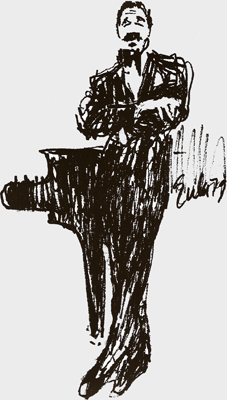
Despite his smooth charm and dapper elegance, quintessential cabaret artist Bobby Short considered himself a saloon singer. Born Robert Waltrip Short on September 15, 1924 in Danville, Illinois, he was the ninth of ten children. A child prodigy, Short began traveling to Chicago and New York to play vaudeville and roadhouses at a young age.  He sang on the radio and performed in nightclubs such as The Apollo Theater, long before earning his high school diploma.

Known primarily for his interpretations of 20th century masters Cole Porter, Duke Ellington, George Gershwin, Noël Coward, and Rodgers & Hart, he is considered a master interpreter of the Great American Songbook. In the 1940s and 1950s, Short honed his signature style in clubs in New York, Los Angeles, and Paris. In 1968, he landed a two-week gig at the Café Carlyle at the Carlyle Hotel in New York City, which he parlayed into a nearly four decade run. There, he became a symbol of high-society Manhattan nightlife, winning over a fan base that included royalty, movie stars and politicians.

Although best known for his intimate live performances, Short also recorded dozens of albums and earned three Grammy nominations, including one for 1993’s Late Night at the Café Carlyle. He appeared on television and in cameos in a handful of films, including Woody Allen's Hannah and Her Sisters. He also wrote two autobiographical books, Black and White Baby and Bobby Short: The Life and Times of a Saloon Singer.

Short died of leukemia on March 21, 2005 at the age of 80, just weeks befor his much-anticipated return to the Café Carlyle to perform at the 50th anniversary of the club.